
China Top Heavy Duty Pillow Block Bearings Supplier?
China has become a major sourcing center for Heavy Duty Pillow Block Bearings, but low price alone does not identify a dependable supplier. The real test begins with engineering evidence. Can the manufacturer match bearing capacity to shock loads, belt tension, vibration, and continuous operating hours?
Robert Errichello, a respected bearing-failure analyst, expressed a useful principle: “A bearing failure is usually a symptom, not the root cause.” This idea matters when evaluating Chinese suppliers. A cracked housing may indicate poor installation. Early overheating may reveal inadequate grease, excessive preload, or misalignment. The bearing itself is not always guilty.
Look closely.
A capable supplier should provide material specifications, heat-treatment records, dimensional inspection data, and traceable batch numbers. The housing should resist deformation under real loads, not only laboratory measurements. Seals must suit dust, moisture, temperature, and washdown conditions. Grease passages should remain accessible beside the shaft, even in crowded machinery.
This guide examines how to identify a reliable China Heavy Duty Pillow Block Bearings supplier through technical capability, quality control, customization, and after-sales support. It also considers practical details, such as mounting tolerance, shaft fit, relubrication intervals, and packaging during ocean transport.
Some recommendations may appear obvious. They are still missed.
No supplier is perfect. Even a well-documented factory can experience process variation, delayed communication, or inconsistent inspection discipline. Buyers should verify claims through samples, audits, test reports, and controlled trial orders. A careful decision may take longer, but it can prevent repeated downtime, damaged shafts, and expensive emergency replacements.
What Is a Heavy-Duty Pillow Block Bearing?
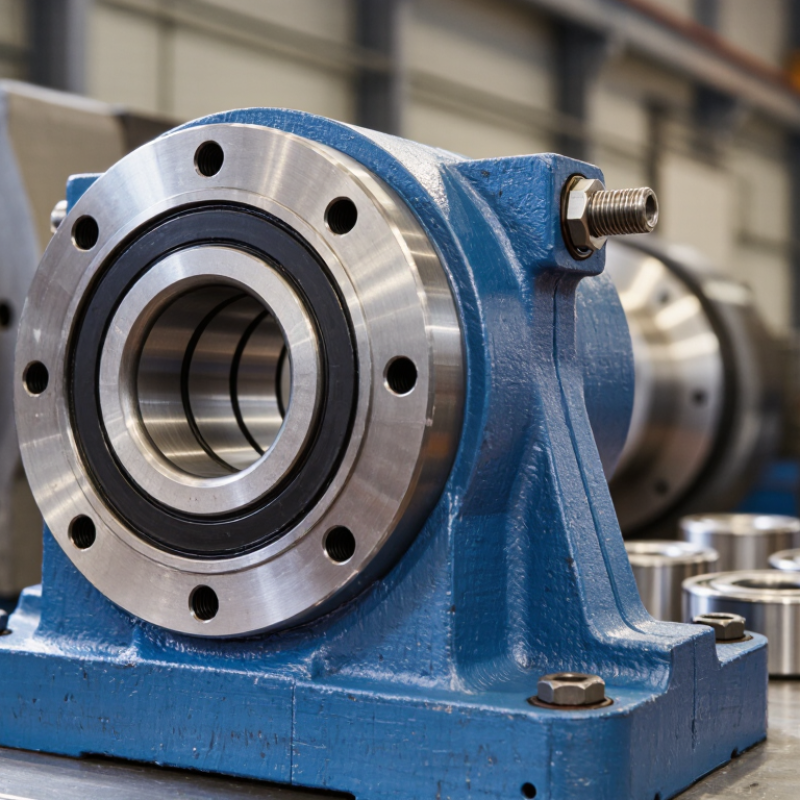
A heavy-duty pillow block bearing supports a rotating shaft inside a mounted housing. It combines a bearing insert, rigid base, seals, and fastening hardware. The housing usually uses cast iron or steel for demanding industrial service. Its design helps carry radial loads and moderate axial loads while simplifying installation.
Heavy-duty does not mean “indestructible.” Load capacity depends on speed, lubrication, shaft alignment, and contamination. ISO 281 defines L10 life as the operating time when 90% of identical bearings are expected to survive under stated conditions. That figure is useful, but field conditions are rarely perfect. The U.S. Department of Energy reports that motor-driven systems consume about 70% of industrial electricity in the United States. Poor bearing alignment can increase friction and waste energy across these systems. In practice, dust, vibration, and loose mounting often shorten service life more than expected.
Tips: Check the dynamic load rating, shaft diameter, sealing type, and relubrication interval. Leave room for thermal expansion. Measure vibration after installation. A slightly warm housing may be normal; a rapidly rising temperature is not. I have seen oversized units fail early because the shaft was bent. Supplier certificates, dimensional inspection, and traceable test records matter when selecting a heavy-duty pillow block bearing.
China Top Heavy Duty Pillow Block Bearings Supplier? - What Is a Heavy-Duty Pillow Block Bearing?
| Data Dimension | Typical Information | Practical Significance |
|---|---|---|
| Definition | A heavy-duty pillow block bearing is a mounted bearing assembly consisting of a housing and a bearing insert designed to support a rotating shaft. | It provides shaft support while simplifying installation, alignment, lubrication, and replacement. |
| Main Components | Cast or fabricated housing, rolling-element bearing insert, seals, locking device, grease fitting, and mounting holes. | The housing carries external loads, while the insert supports shaft rotation and reduces friction. |
| Common Bearing Type | Single-row deep-groove ball bearing inserts are widely used; spherical roller bearing arrangements are selected for very high radial loads. | The rolling-element design determines load capacity, speed capability, and permissible misalignment. |
| Housing Materials | Ductile iron, cast iron, pressed steel, stainless steel, or engineered polymer are typical options. | Ductile and cast iron offer high rigidity; stainless steel improves corrosion resistance; polymer reduces weight and noise. |
| Typical Bore Diameter | Common mounted-bearing bore sizes range approximately from 20 mm to 100 mm, while specialized heavy-duty units may be larger. | The bore must match the shaft diameter and the selected locking method. |
| Typical Housing Styles | Two-bolt, four-bolt, split, take-up, and flange-mounted configurations are commonly used. | Housing geometry determines mounting flexibility, shaft access, and the ability to adjust belt or chain tension. |
| Locking Methods | Set-screw locking, eccentric-collar locking, concentric-clamp locking, and adapter-sleeve mounting are common methods. | The locking arrangement affects installation accuracy, holding strength, vibration resistance, and shaft damage. |
| Load Capability | Designed primarily for radial loads; many assemblies can also carry limited axial loads depending on the insert and mounting arrangement. | Equivalent dynamic load, static load, shock loading, and load direction must be evaluated during selection. |
| Permissible Misalignment | Self-aligning inserts commonly accommodate several degrees of angular misalignment; the exact value depends on the bearing design. | Self-alignment helps compensate for shaft deflection, mounting errors, and housing deformation. |
| Sealing Options | Contact seals, rubber seals, labyrinth seals, and flinger-type protection are used according to contamination and speed requirements. | Effective sealing protects the lubricant from dust, water, fibers, and other contaminants. |
| Lubrication | Pre-greased sealed inserts are common; relubricatable designs include a grease fitting and lubrication channel. | The correct grease type, quantity, and relubrication interval help control heat, wear, and premature failure. |
| Operating Temperature | Standard grease-lubricated units are often used around −20°C to 100°C; higher temperatures require suitable seals, grease, and internal clearances. | Temperature limits are application-specific and should be confirmed from the bearing and lubricant specifications. |
| Speed Consideration | Allowable speed depends on bore size, bearing type, lubrication, sealing, balance, and applied load; heavy-duty designs generally prioritize load capacity over maximum speed. | Excessive speed can increase heat generation, vibration, lubricant degradation, and seal wear. |
| Typical Applications | Conveyors, crushers, fans, agricultural machinery, material-handling equipment, mining systems, processing lines, and industrial drive assemblies. | The pillow block format is suitable where shafts are supported externally and convenient maintenance is required. |
| Installation Requirements | Clean shaft surface, correct shaft fit, aligned mounting surface, properly tightened fasteners, and appropriate axial positioning are essential. | Incorrect installation can cause creep, vibration, overheating, uneven loading, and reduced service life. |
| Selection Checklist | Evaluate bore diameter, radial and axial loads, speed, temperature, contamination, shaft material, mounting space, sealing, lubrication, and expected life. | A complete operating profile is necessary to select a safe and economical heavy-duty bearing assembly. |
| Relevant Technical Data | Bore diameter, outside diameter, housing width, center height, dynamic load rating, static load rating, limiting speed, mass, and mounting-hole dimensions. | These values should be checked against engineering drawings and applicable bearing standards before purchase or replacement. |
Note: Actual dimensions, load ratings, speed limits, temperature ranges, and service intervals vary by bearing series, housing design, clearance, seal type, lubricant, and operating conditions.
Related Posts
-
Top Heavy Duty Pillow Block Bearings Suppliers
-

2025 How to Choose the Right Pillow Block Bearings and Shaft for Your Needs
-
Top Benefits of Using Small Pillow Block Bearings for Your Projects?
-

How to Choose High Speed Pillow Block Bearings for Optimal Performance
-
Top 10 Best High Speed Pillow Block Bearings for Optimal Performance?
-

2025 How to Choose the Right 25mm Pillow Block Bearing for Your Project